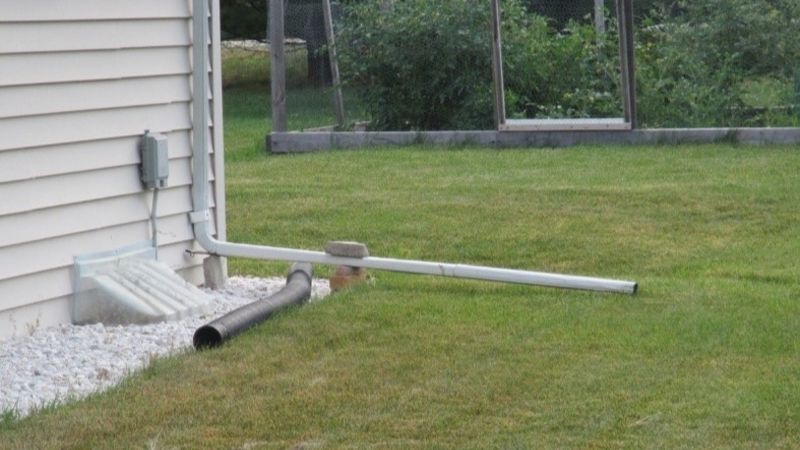
A downspout does only half its job if it empties roof water directly beside the foundation. Downspout extension ideas focus on moving that discharge farther away while keeping the outlet open, stable, and easy to inspect.
The right setup depends on yard slope, foot traffic, landscaping, local drainage patterns, and how much roof runoff reaches each downspout.
Start With the Existing Drainage Pattern
Before adding an extension, watch where water naturally travels. A slight downhill grade can help carry runoff away, while a low area near the wall may send water back toward the house.
Look for muddy strips, washed mulch, standing water, or splash marks around the outlet. These signs show where the current discharge is going instead of where you want it to go.
Measure the Route, Not Just the Distance
An extension should follow a clear path that doesn’t create a tripping hazard or send water toward neighboring structures.
Homeowners comparing broader exterior maintenance ideas can use the same inspection to identify grading and landscaping issues around the house.
Use Above-Ground Extensions for Easy Access
Simple hinged or removable extensions are practical because they remain visible and can be checked for leaves, animal nests, or damage. They can also be moved temporarily during mowing or yard work.
Rigid sections tend to stay where placed, while flexible extensions can route around shrubs or obstacles. Whichever style is used, the outlet should remain open and point toward an area that can absorb or continue carrying water.
Ideas from home project resources can help when coordinating drainage improvements with other outdoor maintenance.
| Extension Type | Useful Feature | Possible Limitation |
|---|---|---|
| Rigid extension | Stable water direction | Can obstruct walkways |
| Flexible extension | Routes around obstacles | May shift or sag |
| Hinged extension | Moves for mowing | Requires repositioning |
| Buried drain | Cleaner appearance | Harder to inspect |
Consider Buried Drainage Carefully
A buried line can hide the extension and keep lawns easier to use, but it introduces new failure points. Underground pipe needs a suitable outlet, adequate fall, and access for cleaning.
Don’t bury a pipe simply to make runoff disappear from sight. If it ends in poorly draining soil or a low area, water may collect underground and eventually return toward the foundation.
For landscaping-oriented planning, residential design inspiration may help integrate visible drainage features more naturally into planting beds and exterior spaces.
Keep Outlets Clear and Stable
Extensions can fail when the discharge end becomes buried in mulch, pressed into soft soil, or blocked by leaves. A small amount of movement over time can also redirect water toward the house.
Inspect outlets after storms and landscaping work. If water is cutting a channel into the yard, consider a splash block, gravel area, or another stable surface that spreads the flow.
Where Downspout Extensions Often Go Wrong
Longer isn’t automatically better. An unnecessarily long flexible pipe may develop dips that hold water and debris, while an extension routed across a walkway can become a nuisance.
Another common mistake is directing several downspouts toward the same low point. That can turn a small drainage issue into a larger saturated area. Each outlet should be considered as part of the whole property drainage pattern, not as an isolated piece of pipe.
Frequently Asked Questions
How far should a downspout extension carry water?
There is no single distance that works for every property. The goal is to discharge water where the ground slopes away and runoff won’t immediately return toward the foundation.
Can a downspout extension go under a sidewalk?
It can, but buried drainage requires careful routing, proper slope, suitable pipe, and a dependable outlet. Access for future cleaning should also be considered before installation.
Why does water stay inside my extension?
Flexible or buried sections may have low spots, crushed areas, debris, or insufficient slope. Inspect the full route rather than assuming the blockage is at the downspout connection.
Give Roof Runoff a Clear Destination
A good extension doesn’t merely move water a few extra feet. It sends runoff toward a location that can handle it without creating erosion, standing water, or a new drainage problem elsewhere.
Follow the water during the next substantial rain. That real-world test will tell you more about the effectiveness of the setup than its appearance on a dry day.